Retrospective on the Dune Book Series.
Introduction
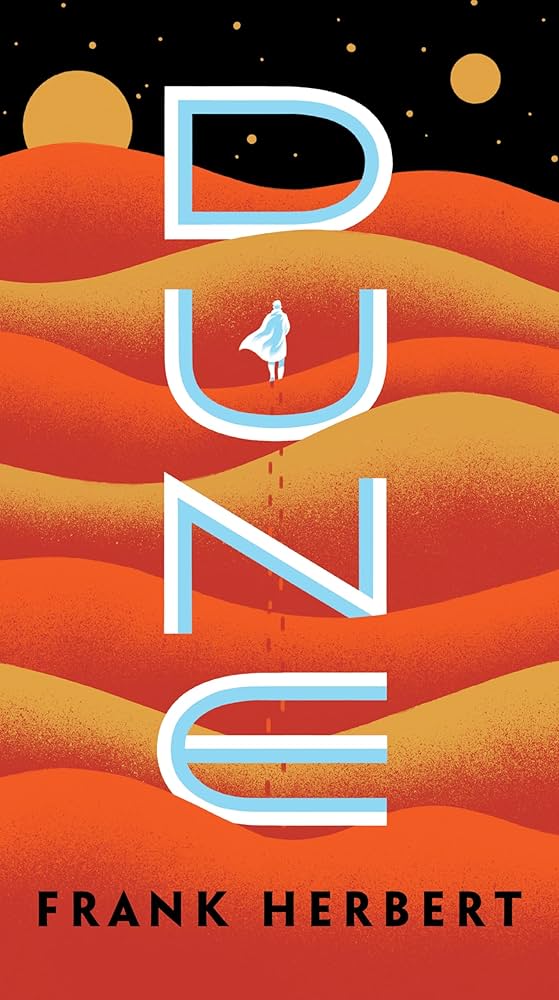
Over the past four years of my life, I wouldn’t say that I was a particularly great reader. I could say I was busy with school, applying to jobs, or anything else, but honestly I was just unwilling to put the effort in to intellectually stimulate myself for my own pleasure. There was one exception however: the Dune series by Frank Herbert.
I initially learnt of Dune after the announcement of the Dune movie by Denis Villeneuve who I am a very big fan of. Before watching any movie based off of a book, I like to read the book first so I decided to do the same for Dune.
I looked up some reviews on Dune before buying the book and found only amazing things being said about the book. With such universal acclaim and popularity, I expected an accessible sci-fi book in the vein of Andy Weir. However, after starting to read the book, it felt as though I was reading a history textbook for class rather than a traditional sci-fi novel. So many new words with very little explicit explanations accompanying them. There was a map and dictionary in the back of the book that I found myself flipping towards after every paragraph I read. I eventually shelved the book after getting a few chapters in since I just could not get myself to enjoy reading a book like this. I also skipped watching the Dune movie since I still believed I should read the book first.
After a few years and the announcement of Dune Part Two, I decided to give the book another crack and pushed myself to actually finish the book. Instead of trying to understand each new sci-fi topic and idea whenever it was introduced in the pages, I rolled with the punches and assumed that it would be explained later on or it was simply not important to know exactly what Herbert is writing, the gist is good enough. With this strategy, I found the proper headspace to immerse myself in the world of Arrakis and Paul Atreides.
In the next several years, I completed the entire original six Dune books by Frank Herbert. As I navigated my way through college and started the transition from young adult to adult (I think I’m still undergoing that transition), the Dune series and Frank Herbert’s writing influenced my worldview greatly.
In the rest of this piece, I want to go over each Dune book and give my review and takeaway from the book. I have tried to write reviews in the past, but I found that I ended up just giving a plot summary without giving very impressive original thoughts of my own. I will attempt to refrain from that here and spoil as little as I can for each book while mainly discussing its themes.
Dune
5/5
As the first book in the Dune series, I have to place it upon a pedestal for simply being as groundbreaking and novel as it was. In 700 pages Frank Herbert crafted the deepest sci-fi, fantasy, and even fictional world that I have ever read. As I mentioned earlier, the barrier to entry is steep and Frank Herbert’s prose is very rusty in this book. His writing is very flowery and it makes the complicated parts of his book a dredge to read. Still, this just adds to the uniqueness of the book to me. While other sci-fi authors try to imagine how people would talk centuries into the future by extrapolating current trends of language, Frank Herbert imagined a future more similar to our medieval past with emperors and dukes and his writing mirrors this time period.
A common thread through many of Herbert’s choices come from a very humanistic personal philosophy he holds. Most sci-fi worlds imagine a world where humans become the background characters to futuristic concepts like robots, aliens, artificial intelligence, etc. but Herbert keeps humanity in the driver's seat of his world. This is not a simple good vs evil story. These are humans opposing other humans and the characters (at least in this first Dune book) change and have legitimate arcs to them. There is even a point in Dune’s history where all humans decided to destroy “thinking machines” (artificial intelligence) because these machines removed agency and spontaneity from the behavior of humans. There was no Terminator style war to destroy the thinking machines, humans eschewed them in the name of preserving their humanity. A very interesting idea considering the trend of AI nowadays. Herbert’s humanism is far, far more clear in his following books, so I will go into further depth then.
The first Dune book also has a rich theme of environmentalism that is not as present in subsequent books. The desert planet Arrakis, its people, its plants, and its animals are all described with great detail, specifically how they adapted to the harsh desert environment - a topic that Frank Herbert was very interested in. The Fremen are modeled after Arabic desert cultures with how they function as a nomadic, tribe-like people with great knowledge of the desert they live on. They know how to avoid the great sandworms, how to collect and conserve the little water in the atmosphere, and create technology to help them survive. As the environment of Arrakis changes throughout the series, it is very interesting to see how the Fremen themselves also change, similar to how native peoples in today’s world struggle with the loss of their indigenous culture through both foreign interference and natural progression.
The strongest point in the book (and all of the books) is the political aspect. The various factions of Dune are modeled after real world political groups. The Atreides are the courageous, noble house ruling through respect and the Harkonnen are the ruthless house ruling through fear. These two house’s struggles drive the main plot of the book. While the Harkonnens are the classic literary antagonists (violent, oppressive peoples), Frank Herbert does not shy from criticizing the Atreides just as much. In fact, Herbert seems to consider the charismatic, righteous Atreides to be just as dangerous as the Harkonnens. While the Atreides are never evil, their benevolent actions must not be mistaken for benevolent ideals. Ruling through respect and ruling through fear result in the same outcome of ruling with the only difference being that respect is safer. No respected ruler deals with rebellions or dissent which is exactly why Frank Herbert looks at the Atreides with a certain disdain. Respected rulers face far less opposition, especially when they are elevated to near-religious status and seen as infallible, exactly what Paul becomes to the Fremen. With this level of admiration Paul holds, he is able to tap into the Fremen’s violent nature from being oppressed by the Harkonnens and the entire Empire and take control. However, Paul’s image as Muad Dib becomes greater than the man himself and even Paul is unable to prevent atrocities from being committed in his name.
Frank Herbert’s libertarian leanings are present within this book and become even more present in future books. While I used to balk at the term libertarian, considering it to just be equivalent to free market capitalism, Herbert’s style of libertarianism isn’t simply anti government. He is anti removing the individuality from humans. I will explore these themes in the future.
As a book, the first Dune is iconic. There are so many concepts that I did not even mention here such as the Bene Gesserit and prescience, but I am saving their discussion for the books where they are more prominent. Such a dense book deserves a perfect rating even if I am not totally in love with it. I still find the book more difficult to read than any of the other Dune books even on a reread. Also, the main conflict being Atreides vs Harkonnen is more simple than the conflict and any of the books that follow. This leads to a more action focused plot vs a political strategy focused plot which is more enjoyable, but Dune isn’t a story of action to me. The story shouldn’t be driven by an event, it should be driven by people. Still, I have to give Dune the acclaim it deserves as a landmark science fiction story.
Dune Messiah
3/5
Of them all, Dune Messiah is the book that I have the least to say about. Frank Herbert seemed to have a similar opinion as it is the shortest one, almost half the size of any of the other books. Serving as the conclusion of the Paul Muad’Dib story, it was controversially received upon its release for transforming Paul from a strong warrior leader to a regretful man who wants only to retire to a peaceful home with Chani. I don’t mind this characterization of Paul. What I do mind is how boring and aimless the book is to me.
Compared to the first Dune, Messiah does not introduce nearly as many new concepts or ideas which makes sense since it’s a sequel but still makes it a less interesting read. The introduction of the Bene Tleilax is probably the highlight of the book and greatly expands the universe, but Herbert saves the depth of this faction for future books.
The bulk of this book is Paul moping around wishing there were some other path for him to follow other than the jihad, but ultimately deciding that this path is the best way forward for him and humanity. I suppose Paul’s inability to prevent the jihad from happening and the oppressive religious regime he has created further reinforces Herbert’s warning against charismatic, powerful rulers.
One thing that I first noticed in this book which holds true for the following books is that Herbert tends to introduce more sci-fi elements with each subsequent entry. Perhaps this is Herbert’s way to keep things fresh. The first Dune was relatively grounded with its sci-fi elements being close to reality (lasers, shields, alien animals mimicking real animals, etc.). In Messiah, Herbert introduces cloning and the Tleilaxu which seemingly come out of nowhere. Not saying this is a good or bad thing, just something I noticed.
Overall, I enjoy this book’s plot and Paul’s story concludes here satisfyingly. He was born a man, lived as a God, and died as a man. The main thing I dislike about Messiah is how filler it feels. Messiah’s main contribution to the universe of Dune is the introduction of Leto II as the new protagonist of the story for the next two books and he is probably my favorite character in all of Dune. The conflict in Messiah is far less high stakes than any of the other stories which makes it the least interesting book to reread which is why I probably won’t be rereading it anytime soon.
Children of Dune
4/5
Children of Dune introduces so many new concepts and has one of the best plots in the Dune series. As the title suggests, the book focuses on Paul’s children, Ghanima and Leto II, as they must fight to protect their lives and empire from threats within and beyond. Leto II's story feels very similar to Paul’s in the first Dune which I think is intentional as Leto II takes over Paul’s goal of preserving humanity. The only difference is Leto II was willing to eschew his life for this goal whereas Paul was never able to let go of Chani making Leto II a far more tragic character and my favorite in the Dune series. Leto II and Ghanima’s relationship is very interestingly described in the book as while they are essentially adults with the memories of all their ancestors, they still share a familial, sibling love for each other that permeates through their interactions. It’s heartbreaking that Leto II had to give up Ghanima just to save humanity.
I love Alia as the villain being possessed by Baron Harkonnen. His return is done very well and makes a lot of sense. For the past two books we have been hearing threats of this “Abomination” and now we can see why the Bene Gesserit fear them so. Alia’s conflict with her grandfather and her internal dialogue shows the deep sin that has occurred to her in her life. She should have never been given this level of consciousness at such an early age. Just another one of Jessica’s mistakes. Alia’s entire situation has a similarity to mental health issues where she retreated to the comfort of the Baron’s evilness as a way to cope with the stresses in her mind. In contrast, while Alia embraced the dark side as a coping mechanism, Leto II and Ghanima instead faced these inner voices head on and emerged stronger and ready to right their family’s wrongs.
Farad’n is also alright as a villain. He just serves as another vehicle to show the power of the Bene Gesserit as he turns over to their side. The return of House Corrino was kind of pathetic overall. None of their plans worked and they just ended up as servants.
One major part about Children of Dune that I am unsure about is the Preacher. He drives much of the early conflict and is essentially stoking a cultural war against Alia’s rule. There is much talk about the mystery of who this Preacher is and what his goals are. I found this mystery to be very engaging and kept me turning pages as I waited for the reveal that he truly is Paul Muad’Dib Atreides, ready to return to his children and help them rule the empire. However, he barely has direct interaction with the plot and his identity is only revealed in the final few chapters. While he has the same body as Paul Atreides, this Preacher is not the same person as he is far more passive and unwilling to take a stand anymore. He is a tired old man who almost reminds me of Luke Skywalker in “The Last Jedi.” If anything, the Preacher’s sermons and conversation with Leto II deliver a look into the Golden Path that he failed to put humanity upon. The Preacher further reinforces that Paul Atreides was not the triumphant, strong ruler as depicted in the first Dune, but rather he was a weak man who could not do what Leto II has done to actually save humanity.
Honestly, Children of Dune is not as memorable to me just as Messiah was. Perhaps it’s because God Emperor of Dune was so fantastic it makes the books leading up to it exactly that. Books written just so that Frank Herbert has all the context necessary to write God Emperor. Children may have an interesting plot, but I don’t find its philosophical discussion interesting to revisit mostly because God Emperor discusses it far better and deeper.
God Emperor of Dune
6/5
It doesn’t get much better than this. This is the absolute peak of Dune and it just might be my favorite book of all time. On the surface, this book seems remarkably boring. There is no main overarching plot which makes it a very frustrating read if you don’t emotionally connect with Leto II. I do happen to connect with Leto II and even teared up a bit at some points like his final moments at the end of the book. Most of the book is just Leto II espousing his philosophy on how humanity should grow and posture itself.
As an immortal man-worm hybrid with all of human history within his memories, Leto II no longer thinks the same as his contemporaries. He tells his lessons in riddles that make no sense unless you know the answer already. He could just speak plainly and explain why he acts so tyrannically, but a lesson is best taught when the student figures it out on their own. This is the heart of Leto II’s character: He has such great love for humanity that he sacrificed his life to nurture it like a father.
After a millennium of stagnation under the Great Houses and CHOAM (OPEC but for spice basically) society, humanity has grown uninspired and close to extinction. There are warring factions that could start a devastating conflict at any moment and there is a lack of scientific progress due to the Butlerian Jihad that has left humanity unable to adapt as they had in the past. Leto II’s solution for this, the Golden Path, was for him to turn into a dictator carefully molding humanity to have the proper characteristics to survive without him. First, he greatly decreased the amount of spice in the universe. No longer could spice be used as a crutch to solve problems. Instead humanity would have to come up with new ways to perform the same actions. This led to the birth of the Ixians, a technology focused group who created many devices to make up for the loss of spice. Space travel became possible without spice thanks to their new navigatory computer. This also had the added effect of making the Spacing Guild almost obsolete. Now that space travel has been democratized with these new computers, no longer would people have to deal with the monopoly of the Spacing Guild, thus giving humanity more freedom overall.
Beyond the new innovations Leto II induced into humanity, Leto II also helped humanity recover what they lost through so many years of leisure: their love for freedom. By being such a loathsome emperor, humans feared Leto II and his power, but they also hated him which is exactly what Leto II aimed for. Through this fear and hate, an enlightenment began to spread throughout the universe. Enlightenment that humankind is meant for more than getting by and signing off our rights to an oppressive government. Numerous rebellions formed against the God Emperor, all put down without mercy to further reinforce hate towards him. Eventually, when Leto II finally met his end, humanity rejoiced and took advantage of their newfound freedom. The collective scarring of his autocratic rule will prevent any future dictatorships from taking hold since humanity now has the tools necessary to oppose such a government. The American Revolution had a very similar effect across the United States as Americans rejected any form of government similar to a monarchy and created the world’s first democracy with many guardrails placed to prevent the people from accepting a dictator (in theory).
As I describe the many atrocities of Leto II, it is easy to imagine him as an uncaring God, doling out punishments without remorse. However, as I mentioned earlier, Leto II loves humanity. He does not take any pleasure in his actions and wishes there were any other possible course. Even when he has to execute dissenters, he does so painlessly. He takes great joy when humanity makes the necessary advancements to cope under his rule. Despite the physical and mental changes his transformation has caused him, Leto II is still human under that wormy facade and does not want to be remembered as solely an evil monster. He hides his journals across the empire with the aim for them to be discovered far in the future after humanity is in a better place so that his sacrifice can be recognized. Leto II is essentially Paul with far greater courage. The epitome of what House Atreides stands for.
Beyond the anguish he feels for his rule, Leto II also suffers from a severe depression as a result of his strong prescience ability. Since he is able to see the future, he identified the Golden Path for humanity when he first transformed into a sandworm and has been moving lock step in accordance to his vision ever since. However, such a life is incredibly boring to Leto II and Paul felt the same in Dune Messiah. Never being surprised by life, almost like you are on autopilot, has a toll of constant boredom. Oftentimes, I have wished to know what the right actions are at any moment to prevent myself from making mistakes. However, there are also many times when acting without fully knowing has led to me growing as a person or experiencing some other benefit. There’s a quiet beauty in ignorance that we should all never forget about, an ignorance that Leto II eschewed to save humanity. There is also the question whether Leto II truly had no other Golden Paths to follow. He insists that his way is the only way, but if he never attempted to stray from the path and explore other options. House Atreides is known for their level of grandiose, so it may be that Leto II had a personal interest in saving humanity through a convoluted, epic plan. Perhaps there was a more peaceful way to save the universe that Leto II avoided by following his plan too closely.
This book is where Frank Herbert’s libertarian ideology is most present. Herbert hated the idea of humanity being coddled and controlled by the government, thus he wrote this story where humanity is saved only after overthrowing their oppressive government and learning to live for themselves. While I don’t consider myself a libertarian, there is something to be admired by this interpretation of libertarianism. While many libertarians today only want to replace the government with a free market of services, Frank Herbert would reject that as it does not preserve individual freedom. What is the difference if someone is ruled by a dictator vs a CEO? Frank Herbert’s brand of libertarianism aims for people to become independent and only rule over themselves to create the best person they can be. I find this ideal to be very inspiring and incorporated much of it into my own beliefs. Being an independent person constantly growing and trying new things with respect for others is a very peaceful way to live life and I believe it is the ideology Herbert espouses throughout the series but plainly stated in God Emperor.
When people ask me if they should read the Dune series, I tell them to make sure to power through just to get to God Emperor of Dune. This is the kind of book you think about for ages after reading it. Truly one of the best books I’ve ever read.
Heretics of Dune
4/5
I was very apprehensive when I started to read the next book after God Emperor of Dune. God Emperor left the Dune series on such a high note of humanity freeing itself from its shackles and beginning anew. Any stories afterwards would inevitably introduce a new conflict and make the ending of God Emperor less optimistic. Also all of the characters that I had grown to love in the original tetralogy were dead so even motivation to continue reading. Nevertheless, I continued the series trusting that Frank Herbert would not let me down, and he did well enough with Heretics of Dune.
One of the most interesting parts about Heretics of Dune is how the universe has changed after the death of the God Emperor Leto II. Humanity has indeed expanded, but this has not been a peaceful endeavor. Immediately after Leto II’s death and this government collapsed, there was a period of instability that caused a famine and the deaths of billions, all of which Leto II foresaw and allowed as a necessary culling to force humanity to grow stronger and venture into new frontiers. Thus, humanity is scattered across the universe in a very decentralized manner with each planet acting very independently, very different from the House structure of Paul’s time and the dictatorship of Leto II. Alongside the political differences, there is a philosophical difference among this new humanity that Leto II induced. Humanity is far less willing to accept tyrannical rule over them and less willing to rule over others tyrannically due to scars from the God Emperor’s rule.
Despite this book marking a hard discontinuity for the series in terms of individual characters, the main factions remain the same with some additions. Instead of having a main point of view (such as Paul or Leto II in the previous books), the story jumps between multiple characters rapidly which gives this book a far bigger roster of characters than normal. Taraza, Miles Teg, and Odrade are amazing characters to follow.
Taraza is the Reverend Mother Superior (leader) of the Bene Gesserit and acted very similarly to the Bene Gesserit leaders we knew from the older books. She is very elitist and likes to control her underlings. She suppressed her emotions and took responsibility for difficult decisions. While this made her a strong leader, she was unable to think spontaneously or creatively, a limitation she acknowledged by putting more responsibility into Teg and Odrade.
Miles Teg is the Bene Gesserit’s military commander and his respect alone often ends battles as the enemies throw down their arms when they hear he is on the battlefield. Despite his combat abilities, Miles Teg’s empathy is his biggest advantage above all others. His emotional connection to those he loves and those he hates allows him to make decisions not purely based on logic. This characteristic allowed him to act with more agency and be less elitist. He is almost the voice of reason among the Bene Gesserit characters, pushing them to act better.
Odrade shares this emotional characteristic and is the reason why she was made Reverend Mother after Taraza. She correctly identified how elitist the Bene Gesserit has acted and makes great pains to act in a more egalitarian manner. She attempts to make truces with the Bene Gesserit’s enemies instead of simply vanquishing them in the name of protecting human agency. Odrade and Teg act as the main drivers of change within the Bene Gesserit, a change that is only fully realized in Chapterhouse: Dune.
The Bene Tleilax emerge as the principal villains in this story as they compete with the Bene Gesserit for influence over the old empire. They have been working in the shadows for the past few books and we finally are allowed a peek into their secretive organization and their hidden religion. Their own elitist worldview acts as juxtaposition to the Bene Gesserit and forces the latter to change their ways to oppose the Tleilaxu effectively.
While I have refrained from giving character descriptions such as these in my reviews, I believe it is necessary for Heretics as this is the most character and action focused story in the entire series. Frank Herbert really changed his style for this book. Instead of discussions of philosophy and politics, he writes action set pieces and duels. The characters themselves instead contain the complexity Herbert is known for. Each character that I mentioned and even the ones that I did not mention go through entire arcs and have their own internal dialogues that are fascinating to follow.
There’s some weird parts of this book that I should talk about though. Heretics introduces the Honored Matres who eventually become the main antagonists in Chapterhouse. They are a group of evil, female rulers who control their populations through sexual slavery. Essentially, they rape people to become subservient. It made me rather uncomfortable to read their parts and I’m not sure why Herbert wrote it this way.
Overall, Heretics of Dune is a good book, but I wouldn’t call it a very good Dune book.
Chapterhouse: Dune
2/5
While reading the first five Dune books, I gave myself a break between each to read other books (or just consume brainrot). I also took my sweet time reading each book. However, for Chapterhouse: Dune, I started it immediately after Heretics and I finished it within a few weeks, far faster than the months it took me to get through the other books. Perhaps it’s because I graduated college and thus had nothing better to do. Either way, I believe this made me appreciate Chapterhouse a lot less since I was a tad bit fatigued from the Dune universe after reading Heretics.
Similarly to Heretics, Chapterhouse is a lot more action focused than the initial Dune books, but less action focused than Heretics. There is a great amount of politicking between Odrade, Duncan, and the Honored Matres, but it doesn’t come to a satisfying ending which is my overall criticism of the book. The ending gets resolved far too easily. The many different story lines being built up throughout the book converge without warning and it almost feels like an after thought by Herbert to finish the story.
While Frank Herbert was writing this book, his wife passed away. He wrote a dedication to her at the end of the book which was very beautiful to read. Soon after his wife passed, after Chapterhouse: Dune was published, while he was writing the final Dune book, Frank Herbert also died leaving the Dune series unfinished. Perhaps many of the unfinished threads left by Chapterhouse would have been tied up in the final Dune book, but that is something we will never know and nevertheless does not make up for Chapterhouse’s ending.
The main story of Chapterhouse: Dune, that of the Bene Gesserit’s continued conflict with the Honored Matres, is about as good as the story in Heretics. Odrade and her inner monologue were the best parts of the story. She is a very emotional character having to give difficult orders that wound her deeply on the inside. Her internal conflict paints the picture of a leader who was thrust into leadership and being forced to act rather than a leader who sought after the role. Her egalitarian ideology from Heretics is still present and she continues to pursue a policy of compromise with the brutal Honored Matres eventually finding a solution to end their war.
Despite Odrade’s heavy lifting, I can’t bring myself to like this book. There are multiple story lines that serve no purpose and aren’t resolved well and there is even more weird sex stuff, this time involving a child character. I have no idea why Frank Herbert made that decision. The story is fine, but a bit repetitive from Heretics. I don’t think any of the new characters are all too interesting. Chapterhouse: Dune is definitely my least favorite Dune book and it’s sad the series went out on such a low note.
Conclusion
I don’t plan on reading the books written by Bryan Herbert as I’ve heard mixed reviews on them and it feels like he’s milking his father’s legacy to be honest. While it’s tragic that the Dune series has been left unfinished, it’s better off unfinished than poorly completed in my opinion.
Of course I’d be remiss if I didn’t give a short review on the Dune movies as well: I found Dune Part One to be good but kind of boring and I found Dune Part Two to be amazing but falters a bit at the end. Obviously neither of them match the depth and complexity of the books, but Denis Villeneuve does an amazing job adapting what’s possible to the screen. Recently, the trailer for Dune Part Three came out and it seems to be the most unique movie, diverging greatly from the books. I honestly can’t wait to watch it.
While I may be putting my Dune books onto my bookshelf for a long time, their messages and themes will stay with me as I continue reading and living. Despite the technological advancements occurring around me, this world is still a human focused world and each of us has control over ourselves to live our best lives. On a more negative note, every sci-fi book I read now will feel hollow compared to Dune.
I don’t think I will attempt to read a saga as long as Dune anytime soon. I find that I get fatigued by the same style and author quickly and it’s best for me to jump genres. Also it took me over five years to finish the Dune series and it’s very hard to give such a time commitment to any other series. They would legitimately have to be on Dune’s level for me to consider it and there are not many series like that in existence.
As I finish this retrospective on the Dune series, I want to note that I am still very rusty at writing long form reviews about any kind of media. I have written short pieces about books and movies that I think are concise and neatly written, but my long form writing I am far less sure about. I wrote a review for the Neil Postman book “The End of Education” where I felt I simply reiterated the points made in the book without adding my own analysis or perspective on the topic. In this piece, I attempted to divulge as little as I could about each book’s story, and I left out so many details for each book. Hopefully I also provided enough of my own thoughts to make a good review but that is up to the reader. I will say that I think I could have written a better review for Heretics and Chapterhouse if I gave myself more time. Since they were the last books to review, I kind of wanted to get through them quickly and move on from Dune entirely. They are also more action focused, so it was harder to give my thoughts without discussing the plot itself and spoiling the entire book.
However, beyond wanting to give my thoughts on Dune, this review was a success for me to hone my writing skills, prevent my brain from degenerating further, and collect my thoughts on each Dune book. Thank you for making it this far.